How to Turn Performance Review Feedback into Effective Development
After performance reviews, most organisations are left with the same problem:
A long list of development needs.
But no clear way to turn them into a focused development plan.
Some requests are vague.
Some overlap.
Some don’t feel like training needs at all.
And yet, you’re expected to turn this into something structured, prioritised and worth investing in.
If you get this wrong, you risk:
- Sending people on the wrong courses
- Wasting budget
- Not actually improving performance
So how do you go from feedback… to focused, effective development?
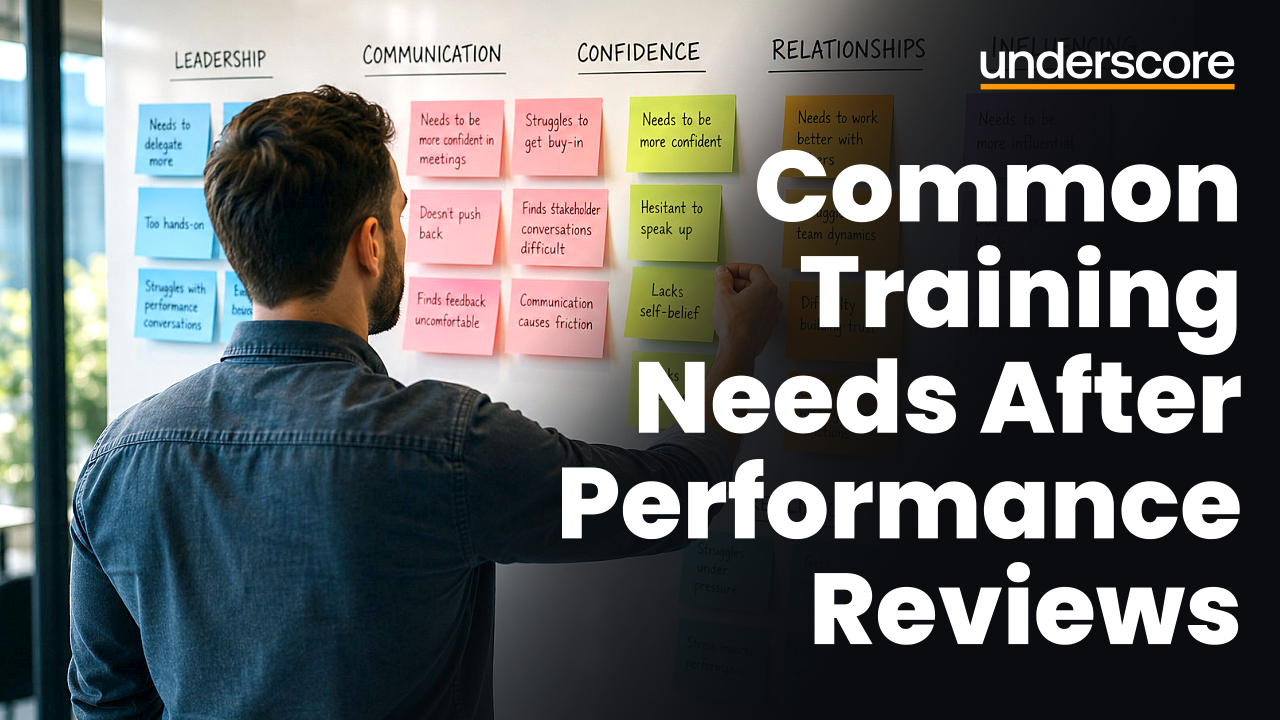
Step 1 – Group feedback into themes
Start by stepping back from individual comments.
Looking at feedback person-by-person is where most people get stuck. It feels messy and inconsistent.
Instead, look for patterns across the organisation.
Typical themes include:
- Leadership and management
- Communication and influencing
- Confidence and resilience
- Systems and tools
- Project or delivery capability
What this looks like in practice
Let’s say you’re reviewing feedback across a team and you see:
- “Needs to delegate more”
- “Struggles to manage performance”
- “Avoids difficult conversations”
At first glance, these look like separate issues.
But they all point to one thing:
👉 A management capability gap
Once you group feedback like this, the problem becomes much clearer — and much easier to solve.
Why this step matters
Without grouping:
- You end up with dozens of “individual” needs
- You struggle to prioritise
- You risk organising lots of disconnected development
With grouping:
- You see the real capability gaps
- You can scale training across teams
- You make better decisions, faster
Once you've grouped feedback into themes, you'll often find the same capability gaps appearing repeatedly. Our guide to The Most Common Training Needs Identified in Performance Reviews explores the development themes that organisations see most often.
Step 2 – Identify the real capability gap
This is where many training plans go wrong.
Performance review feedback often describes symptoms, not causes.
Example
Feedback says:
“Needs to be more confident in meetings”
That could mean:
- They struggle to influence stakeholders
- They don’t structure their ideas clearly
- They lack confidence speaking up
- They don’t feel credible in their role
Each of these may require a different type of support or development.
How to get to the real gap
Ask:
- What is this person actually struggling to do?
- What behaviour needs to change?
- What skill is missing underneath this feedback?
Another example
Feedback:
“Not great with stakeholders”
Possible underlying gaps:
- Poor communication structure
- Lack of influencing techniques
- Avoiding difficult conversations
- Not understanding stakeholder priorities
👉 That’s not a vague problem anymore
👉 That’s a clear development need
Why this step matters
If you don’t do this properly:
- You’ll pick generic training
- The course won’t land
- Nothing will change afterwards
This is the difference between:
👉 Training that ticks a box
👉 and training that actually improves performance
Before Moving On...
One final check before you start looking at training solutions.
Not every performance issue is caused by a capability gap.
Sometimes the real issue is:
- Unclear processes
- Lack of resources or time
- Conflicting priorities
- Poor management support
- Unclear expectations
For example, if someone is struggling to meet deadlines, the problem may not be a skills issue at all. It could be workload, competing priorities or unclear processes.
Before investing in development, make sure the issue is genuinely related to capability.
Only then should you start looking at training options.
Step 3 – Map gaps to the right training
Once you understand the real capability gap, the next step is straightforward:
👉 Match it to the right training route
Simple mapping examples:
- New managers lack confidence
- Likely training route: Leadership & Management training
- Struggling to influence
- Likely training route: Influencing & communication training
- Conflict in teams
- Likely training route: Difficult conversations and conflict training
- Low confidence under pressure
- Likely training route: Resilience training
- Poor stakeholder engagement
- Likely training route: Influencing and business partnering training
- Reporting takes too long or relies on manual spreadsheets
- Likely training route: Excel / Power BI training
- Projects consistently miss deadlines or lack structure
- Likely training route: Project management training
What good looks like
Instead of saying:
“They need some training”
You can now say:
“We need leadership training focused on delegation, performance conversations and team management”
That’s a completely different level of clarity.
Common mistake to avoid
Booking training based on:
- Course titles
- What sounds relevant
- What people asked for
Instead of:
👉 The actual capability gap
Step 4 – Decide the right training approach
Even with the right training identified, there’s still an important decision:
👉 How should it be delivered?
Ask yourself
- Is this for 1-2 people, a whole team, or people across multiple teams?
- Are the needs consistent or mixed?
- Is this a short-term fix or a wider capability issue?
Typical routes
1–2 individuals
→ Public course (cost-effective, quick)
Whole team with same need
→ Private group training (more relevant, tailored)
Mixed or broader needs
→ Structured programme (multiple courses or staged approach)
Example
You identify:
- 12 managers struggling with delegation and performance
The right answer isn't necessarily to send them on 12 separate courses.
The right answer might be a targeted leadership programme focused on delegation, performance conversations and managing people effectively.
Why this matters
This is where you move from:
👉 Booking training
to
👉 Solving a business problem and getting far more value from your development budget.
A quick way to speed this up
If you want a simple starting point, you can use our Training Needs Analysis tool.
👉 It helps you:
- Categorise the challenge
- Identify likely training routes
- Get a practical recommendation
It’s designed as a quick sense-check, not a full solution — but it can help you move faster and avoid second-guessing your decisions.
If you're already working with performance review feedback, our Performance Review Development Planner provides a simple framework for organising feedback, identifying themes and building development plans.
Common mistakes to avoid
Before you finalise your plan, watch out for these:
- Treating every piece of feedback as unique
- Jumping straight to course booking
- Choosing training based on titles, not outcomes
- Trying to solve everything with one course
- Ignoring how the training will be applied afterwards
If you've identified several capability gaps and are struggling to decide where to focus first, our guide on How to Prioritise Training Needs Across a Team or Organisation can help.
Explore the Full Performance Review Development Hub
Looking at performance review feedback from multiple teams or across the wider organisation? Visit our Performance Review Training Needs Hub for practical guidance, tools and training routes.
Bringing it all together
Turning performance review feedback into development doesn’t need to be complicated.
It comes down to a simple process:
- Group feedback into themes
- Identify the real capability gaps
- Map those gaps to the right training
- Choose the right delivery approach
If you’ve got a list of development needs and aren’t sure where to start:
👉 Tell us what you’re trying to improve and we’ll help you identify the right development solution
👉 Or explore our leadership and personal development courses
About the Author

Emma-Jane Haigh
Leadership and People Development Specialist, Executive Coach, and Facilitator. Emma-Jane designs and delivers training that helps managers and teams strengthen communication, build resilience, and lead with confidence. At Underscore, she runs leadership, management, and project management programmes focused on practical skills and real workplace impact.
Need help applying this in your organisation?
We work with HR, L&D teams and business leaders to turn these ideas into practical, instructor-led training that improves day-to-day performance.